Alkaline Noodle Texture vs Instant Noodle Texture: Process Lessons for Product Developers
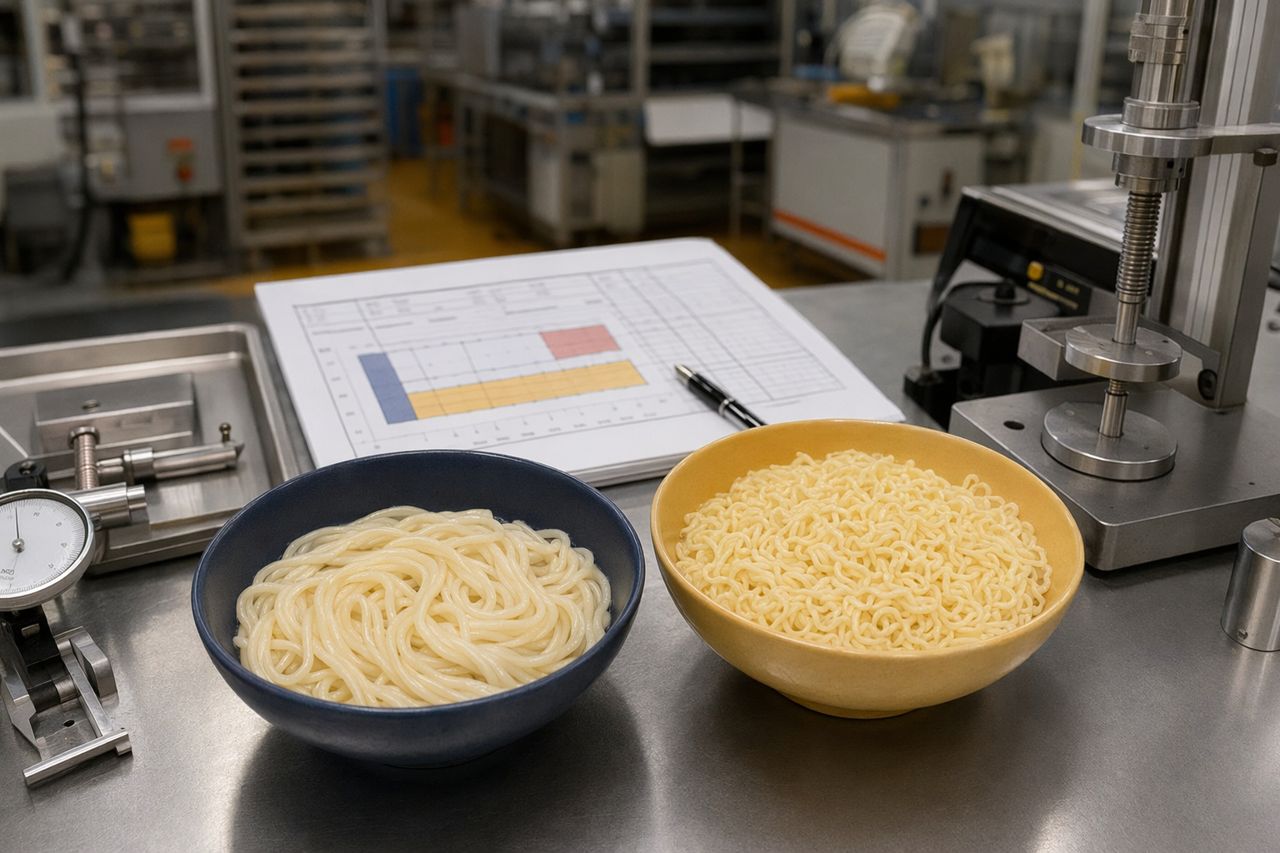
Alkaline noodles and instant noodles may share flour, water, mixing, sheeting, and cutting, but they are not chasing the same texture system.
For product developers, the useful question is not which texture is better. It is which process variables create the bite, elasticity, cooking behavior, and line stability your product needs at factory scale.
As an enzyme supplier for noodle manufacturing, StrandPilot helps noodle factories translate those variables into controlled development work: flour variation, water absorption, pH, sheeting response, steaming, drying or frying, and final eating quality.
This article compares alkaline noodle texture with instant noodle texture from a process-development perspective, then outlines where enzyme strategy can support more predictable outcomes.
Why the comparison matters in a noodle factory
Alkaline noodles are usually evaluated for:
- Elastic chew and resilience
- Smooth, glossy surface
- Firm bite after cooking
- Low cooking loss
- Color and aroma associated with alkaline processing
- Strand integrity during boiling and handling
Instant noodles are usually evaluated for:
- Fast and uniform rehydration
- Springy bite after hot-water preparation
- Low surface mushiness
- Stable block structure through drying or frying
- Consistent texture after storage
- Good separation in the bowl without excessive breakage
Both products use texture language such as firm, elastic, smooth, springy, and chewy. But the process pressure behind those words is different.
An alkaline noodle is often designed around a cooked strand experience. An instant noodle must survive a full industrial transformation: sheeting, cutting, steaming, drying or frying, cooling, packaging, storage, and rapid rehydration.
That difference changes how R&D teams should think about dough strength, starch behavior, water movement, and enzyme selection.
Alkaline noodle texture: controlled elasticity under high-pH conditions
Alkaline noodles typically use alkaline salts to shift dough behavior, color, and aroma. This changes how gluten develops and how starch and protein interact during cooking.
The target is not simple firmness. A good alkaline noodle has controlled elasticity: enough resistance to give a satisfying chew, but not so much toughness that the noodle feels rubbery or slow to bite through.
Key texture drivers in alkaline noodles
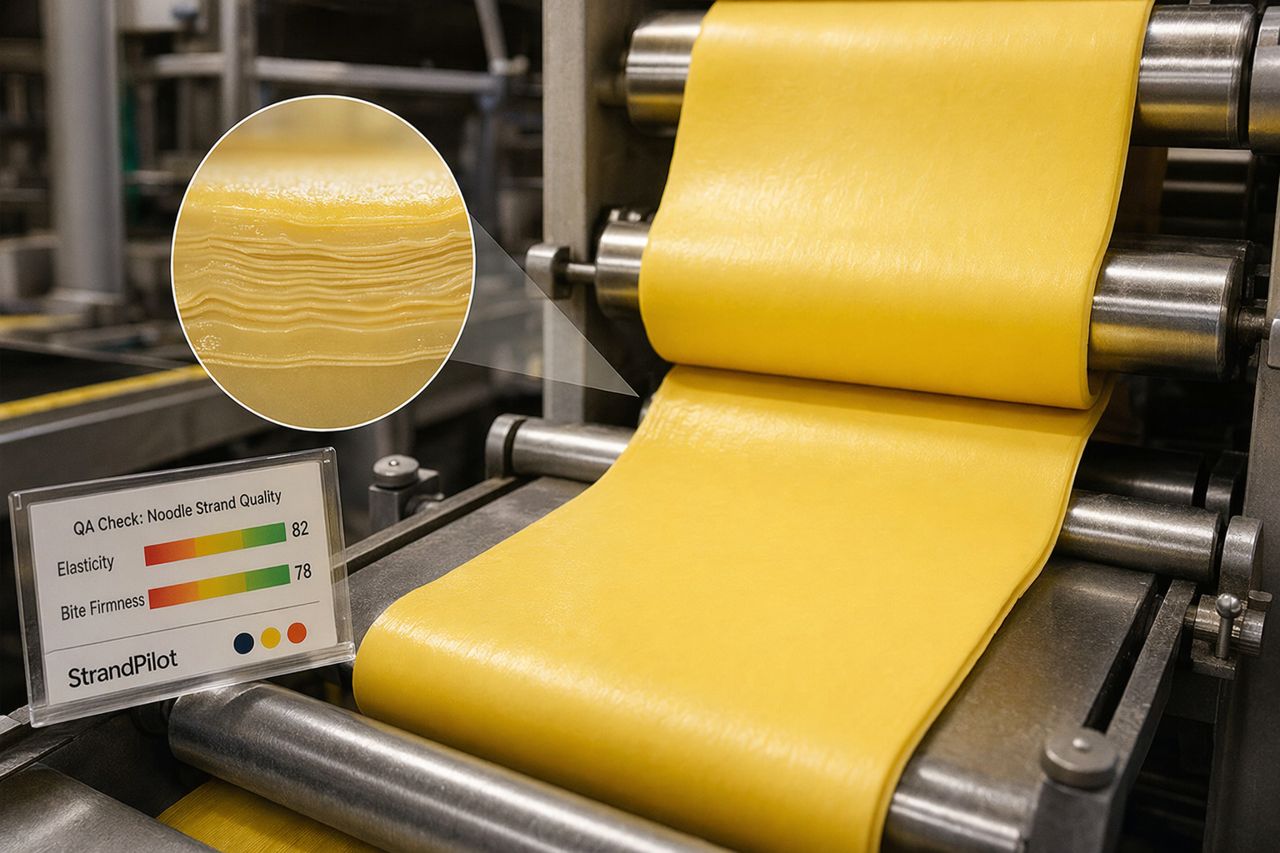
Flour protein quality matters because the gluten network must support sheeting, cutting, and cooking stability.
Water absorption and distribution influence surface smoothness, lamination, and strand edge quality.
Alkaline level and blend affect color, aroma, dough extensibility, and cooking bite.
Mixing and resting determine whether hydration and gluten development are even across the dough mass.
Sheeting pressure and reduction schedule influence strand alignment, bite, and surface finish.
Cooking tolerance is critical because an alkaline noodle should hold its bite through a realistic serving window.
For product developers, the risk is that a formula may look good at bench scale but become unstable on the line. Dough can tighten during sheeting, strand edges can roughen, cooking loss can rise, or the final bite can drift from elastic to tough.
Instant noodle texture: bite that survives processing and returns in the bowl
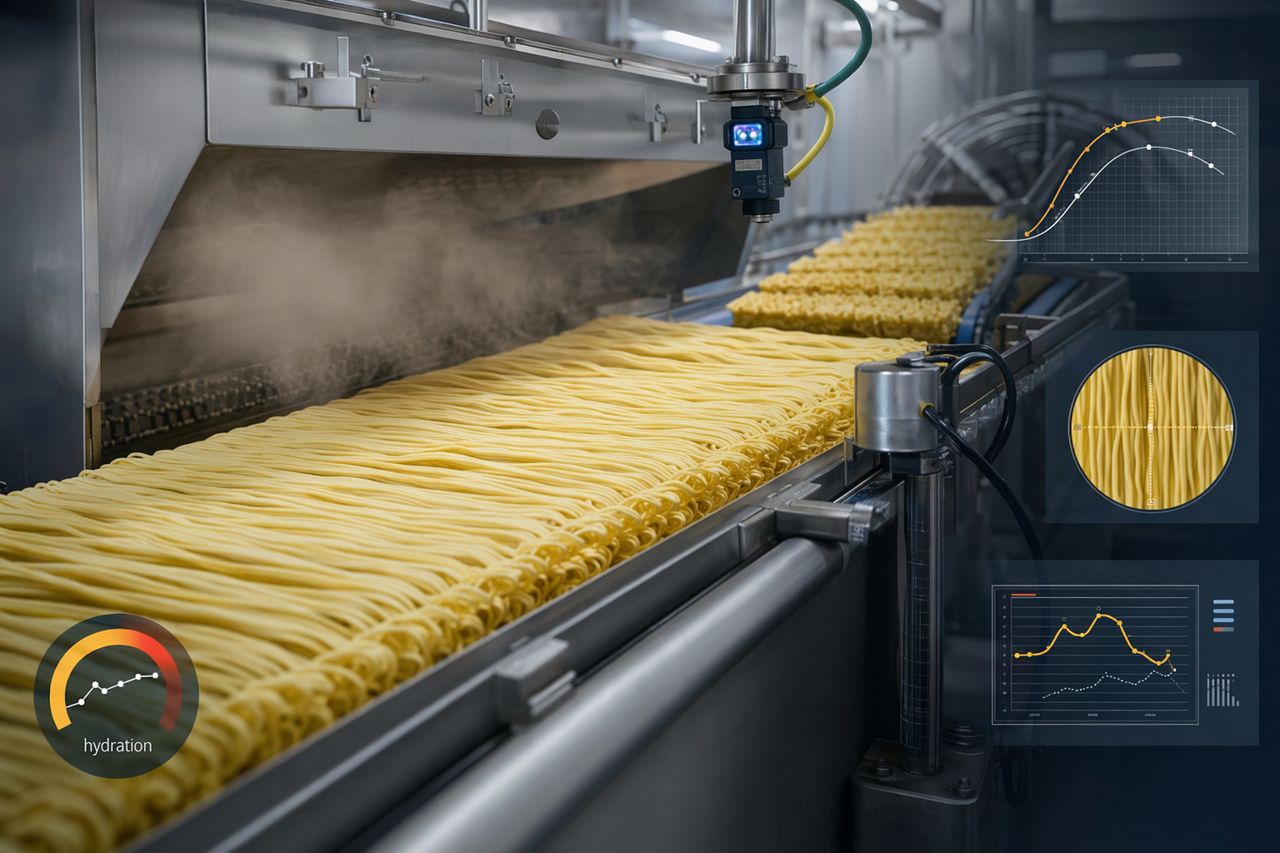
Instant noodles have a more complex texture journey. The noodle is shaped as dough, partially cooked by steam, dried or fried into a stable block, then rehydrated by the consumer or foodservice operator.
That means instant noodle texture is not created at one point. It is built across the entire process.
Key texture drivers in instant noodles
Dough handling must support continuous sheeting without tearing, sticking, or excessive tightening.
Steam treatment sets starch and protein structure before drying or frying.
Drying or frying profile shapes porosity, breakage risk, oil uptake in fried formats, and rehydration behavior.
Block structure must be strong enough for packaging and transport but open enough for rapid hydration.
Rehydration curve must match the target eating occasion, whether cup, packet, bowl, or foodservice preparation.
Post-storage texture must remain consistent across shelf life, distribution conditions, and preparation variability.
The challenge is that an instant noodle can look acceptable after production but fail in the bowl. It may rehydrate unevenly, soften too quickly at the surface, hold a firm core, or lose spring after a short standing time.
What transfers from alkaline noodle development to instant noodle development
There are useful lessons from alkaline noodle work that can transfer into instant noodle R&D.
1. Treat texture as a window, not a single number
Both categories require balance. More strength is not always better. Too much dough strength can reduce sheetability or create a dense bite. Too little strength can increase breakage, cooking loss, or surface breakdown.
A practical development target should describe an acceptable window for bite firmness, elasticity, cooking loss, strand separation, and sensory consistency.
2. Watch the relationship between water and structure
Water distribution is central in both systems. In alkaline noodles, uneven hydration can create rough sheeting and inconsistent chew. In instant noodles, water behavior also affects steaming response, drying or frying efficiency, and rehydration.
R&D teams should track water addition, rest time, dough temperature, and flour lot changes together rather than treating them as separate adjustments.
3. Build line stability into the formulation brief
A formulation that only wins in sensory testing is not enough. It must also run.
For both alkaline and instant noodles, product developers should evaluate:
- Dough crumb consistency after mixing
- Sheet surface and edge definition
- Roller load and dough elasticity during reduction
- Strand cutting quality
- Waste and rework points
- Texture consistency across production time
This is where enzyme systems can be useful: not as a shortcut, but as a controlled tool for narrowing process variation.
What does not transfer directly
Instant noodle development cannot simply copy an alkaline noodle texture target.
Alkaline noodles are often judged after boiling or cooking in a controlled preparation. Instant noodles must recover texture after a dehydration and rehydration cycle. A dough that gives excellent alkaline chew may become too dense for rapid rehydration or too fragile after drying.
Likewise, an instant noodle designed for quick hydration may not deliver the deeper chew expected from alkaline noodle formats.
The process lesson is clear: define the eating target first, then work backward through processing steps.
Where enzyme strategy fits
Enzymes can help noodle manufacturers tune dough handling, starch behavior, and final texture when they are selected against a specific process target.
StrandPilot approaches enzyme selection around factory questions such as:
- Does the dough need more extensibility during sheeting?
- Is the sheet tightening too quickly during reduction?
- Is cooking loss higher than the target window?
- Is the instant noodle block too dense or too fragile?
- Is rehydration too slow, uneven, or mushy at the surface?
- Does flour variation shift bite firmness from batch to batch?
Enzyme functions that may be considered
Hemicellulase and xylanase systems can support water distribution and dough handling, especially when flour arabinoxylan behavior is affecting sheet quality, extensibility, or process consistency.
Amylase systems can influence starch modification, thermal behavior, and rehydration characteristics when used as part of a controlled noodle process.
Oxidative dough-strengthening systems can support network formation where additional bite, strand integrity, or cooking tolerance is needed.
Protease micro-adjustment may be considered when dough is too tight for sheeting or when extensibility needs careful correction.
The right choice depends on flour quality, water addition, pH, salt system, mixing energy, sheeting schedule, steam profile, drying or frying conditions, and the desired bite.
No enzyme should be selected in isolation from the process map.
Development checklist for R&D teams
Before running enzyme trials, define the comparison clearly.
For alkaline noodle targets
- Desired bite: elastic, firm, chewy, or smooth-soft
- Alkaline system and target sensory profile
- Flour protein strength and ash expectations
- Water addition and resting conditions
- Sheeting reduction schedule
- Cooking time and holding tolerance
- Cooking loss and strand surface quality
For instant noodle targets
- Format: cup, packet, bowl, or foodservice
- Drying or frying route
- Target rehydration time and serving method
- Block strength and breakage tolerance
- Surface softness versus core firmness
- Strand separation after preparation
- Texture after standing in broth
For scale-up
- Expected flour lot variability
- Mixer type and dough temperature control
- Line speed and roller configuration
- Steam consistency
- Drying or frying profile stability
- Packaging breakage risk
- QA checkpoints for texture drift
A well-designed trial does not ask whether an enzyme works in general. It asks whether the enzyme helps the factory hit a defined texture and process window more reliably.
Practical process lessons
Lesson 1: Start with the eating moment
An alkaline noodle may need a strong chew after boiling. An instant noodle may need fast recovery after hot-water rehydration. These are different design briefs.
Lesson 2: Do not over-correct dough strength
If a noodle is weak, adding strength may help. But excessive strength can reduce sheetability, slow hydration, or create a tough bite. Balance matters.
Lesson 3: Separate surface texture from core texture
Instant noodles often fail when the surface hydrates too quickly while the core remains firm. Alkaline noodles often fail when the surface becomes rough or cooking loss rises. Track both surface and core behavior.
Lesson 4: Run trials under real line pressure
Bench dough can hide problems. Pilot and production trials reveal whether the formulation can handle continuous sheeting, thermal steps, drying or frying, and packaging.
Lesson 5: Link enzyme choice to a measurable factory issue
The strongest enzyme brief is practical: reduce sheeting variation, improve strand integrity, stabilize bite across flour lots, adjust rehydration, or reduce texture drift after cooking.
How StrandPilot supports noodle factories
StrandPilot works with noodle manufacturers that need formulation support tied to production reality.
Our role is to help R&D and process teams evaluate enzyme options against clear commercial targets:
- More predictable dough handling
- Better alignment between flour quality and texture goals
- Improved cooking and rehydration performance
- Reduced trial-and-error during scale-up
- Sensory consistency across production runs
- Practical support for alkaline, instant, and hybrid noodle formats
We do not treat enzymes as generic additives. We treat them as process tools that must fit the flour, the line, and the eating target.
60-second explainer video
This page includes a faceless explainer video showing how alkaline noodle chew and instant noodle rehydration create different formulation demands. The visual sequence follows flour hydration, dough sheeting, strand formation, steaming, drying or frying, and final bowl texture, with on-screen overlays for rheology, bite firmness, cooking loss, hydration curve, and enzyme dosage windows.
Request a quote
If your team is comparing alkaline noodle chew with instant noodle bite, StrandPilot can help you frame the trial, select enzyme candidates, and align the formulation with your line conditions.
Request a quote using the on-site form and include your noodle format, flour profile, process route, and target texture.